
Vial Filling
Argonaut brings extensive experience filling high-value products, including N=1 personalized therapies, to every vial filling program. Our 100% isolator-based filling provides the highest level of separation and is designed to meet FDA and EU Annex 1 requirements, with capacity from clinical through commercial scale.
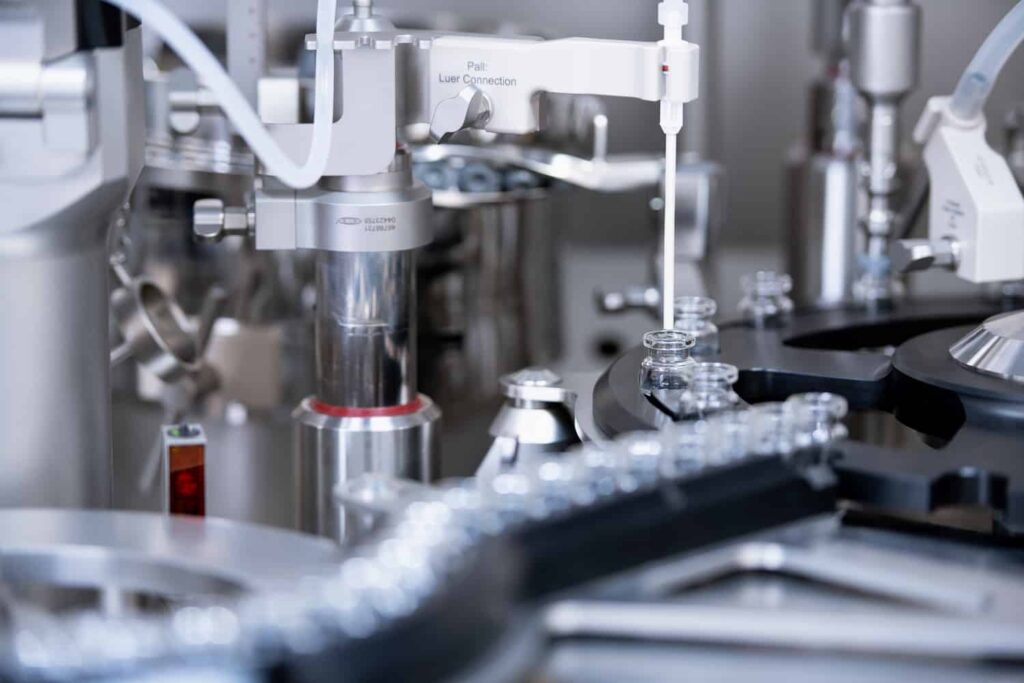
Scale Across Vial Filling Lines.
Our two fully automated, isolator-based filling lines support projects ranging from small clinical batches of just a few hundred vials to commercial campaigns exceeding a hundred thousand vials. As your program needs change, our team works with you to scale manufacturing and maximize yield while maintaining process consistency, product quality, and regulatory compliance.
LOKER LINE
ASTON LINE
Vial Size
2R – 30R
2R – 50R
Fill Speed
Up to ~2,000 vials/hr
Up to ~9,000 vials/hr
Fill Volume
0.25 to 30 mL
0.25 to 50 mL
Regulatory Phase
Clinical and commercial
Clinical and commercial
Formulation Volume
Up to 200 L
Up to 800 L
Isolation Technology
Isolator-based
Isolator-based
Pump
Peristaltic
Peristaltic
Components Used
Ready-to-use (RTU)
Ready-to-use (RTU)
Gas Overlay
Nitrogen
Nitrogen
Weight Checks
100% in-process non-destructive
100% in-process non-destructive
Table 1: Vial filling line specifications
Maximize Your Product Yield.
Every vial lost during filling is a dose that cannot be given to a patient. Lost product delays studies, reduces available doses, and adds cost at exactly the point in development where material is hardest to replace. At Argonaut, every milliliter matters.
That is why we design our processes to maximize yield. Our filling lines can reduce line loss to as little as 25 mL, helping preserve valuable drug product in every vial fill batch.
We maximize your drug product yield through:
- Precise peristaltic filling
- 100% in-process, non-destructive weight verification
- Rescue dosing
- Low hold-up processing
- Non-destructive analytical testing
- Using high-quality components
- Minimal to no glass-to-glass contact
- Stability and analytical planning that minimizes vial consumption
These advantages deliver meaningful impact on yield and overall manufacturing efficiency, especially for high-value biologics, oligonucleotides, vaccines, ophthalmics, and other complex products.
Advanced Vial Filling to Meet the Highest Regulatory Standards.
Vial filling is performed in automated, enclosed isolator lines that meet current regulatory expectations, including FDA and EU Annex 1 requirements. We also support PUPSIT on both our dedicated vial filling line (Loker) and multi-format filling lines (Aston).
Our team brings decades of aseptic manufacturing and quality experience to help sponsors manage risk and navigate evolving requirements for sterile injectable products.
A Fill-Finish Strategy Tailored to Your Program.
No two fill-finish programs are the same.
We help you develop a manufacturing strategy that reflects the unique needs of your formulation, process, and development timeline. Our experience with complex formulations, including LNPs, aseptic formulations, personalized medicines, and biologics, helps inform our strategy to account for formulation-specific processing requirements, product quality, and yield. Whether supporting an early proof-of-concept program, a first-in-human clinical study, or a commercial launch, you will get a practical, science-driven approach to your project.
Support from API Manufacturing to Final Distribution
Sterile fill-finish is just one step in manufacturing a sterile injectable product. You can simplify your overall manufacturing pipeline by engaging our strategic network partners for support, from API manufacturing to final distribution. Project management is simplified and you can request integrated proposals, assign a single project manager to oversee work across organizations, align manufacturing timelines to reduce handoffs, minimize delays, and streamline communication.
We can also work with your preferred manufacturer or service provider to provide an integrated solution.
Our strategic partner network provides access to:
- API manufacturing
- Device manufacturing and assembly
- Labeling and secondary packaging
- Kitting
- Long-term GMP storage
- Distribution and logistics
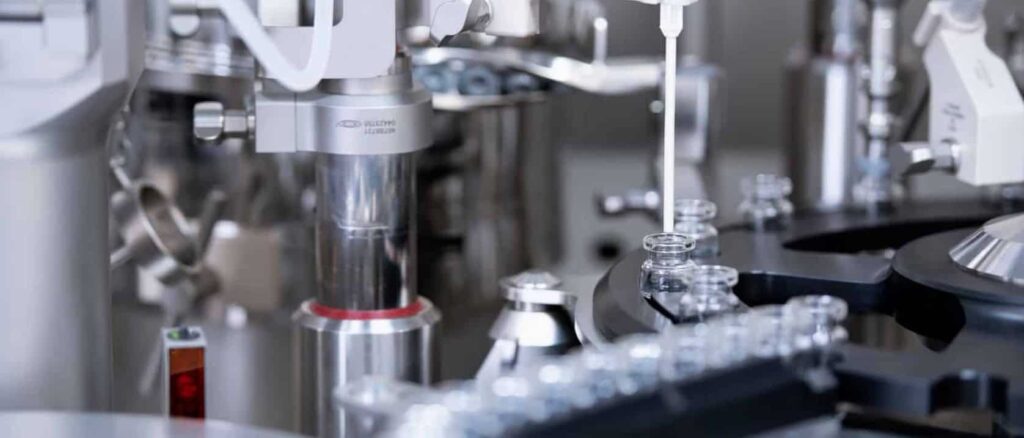
We support every phase of your fill-finish program.
From your first clinical batch to full-scale commercial production, our vial filling lines are designed to support every phase of your program.